

Showtime!
A ‘Racing Car Show’ was created by the British Racing and Sports Car Club [BRSCC] in the late 1950s and it continued through to the late 1970s always in London but at different venues (writes Ian Bamsey). It was established at the Royal Horticultural Halls and soon expanded into the vast Olympia exhibition centre.
However, held in late December and/or early January this event - after a few years given the title of ‘The International Racing Car Show’ - only had access to Olympia every other year. As such in 1972 and 1974 the BRSCC organised instead what it called The Showboat.
In stark contrast to the expansive Olympia event, this was a compact version squeezed into a cross channel car ferry moored on the River Thames in London. It ran for no less than nine days - and the Olympia events were of even longer duration…
I recall as a young lad visiting the bizarre Showboat!
I also recall during the 1980s miscellaneous attempts to establish a replacement Racing Car Show, invariably without ongoing success. However, the pivotal event was the birth of the Autosport International show in January 1991. This was established by Haymarket, then owner of Autosport magazine, at Birmingham’s National Exhibition Centre [NEC].
Autosport International continued annually as a four day event through to January 2025. While it was in the spirit of the earlier BRSCC shows it became ever more commercial.
I still remember a school friend and I getting on the train home from a Showboat and opening our goodie bags to create upon our table a mountain of brochures, badges, pens, mugs, decals, etc. All collected for free whereas a similar amount of loot from an Autosport International show would have cost us a small fortune!
That is the very long established public side. Along the way Autosport International added a dedicated Autosport Engineering show-within-a-show.
Autosport Engineering was inspired by a visit Tony Tobias and I made to the PRI show at Cincinnati in December 1992. At this time PRI was virtually unknown outside of America. It had been established to allow speed shop owners from across every state to come together to view under one roof all of the latest products from racing equipment manufacturers.
Tony had been struggling to sell advertising for Racecar Engineering magazine since it was a new concept and traditionally UK specialists sold directly to racers without placing press advertisements. Speed shops were few and far between in the UK. I suggested we go over and explore PRI. It was a revelation.
Key US racing equipment manufacturers surprised us by not only having heard about our young magazine but by gushing over it. Tony came away with plentiful orders for advertising space. The future of Racecar Engineering - having hitherto been on unsteady financial ground - was thus ensured.
At this time Tony had a contract with Haymarket and after our success at PRI he promoted the idea of a dedicated trade/engineering-orientated section of Autosport International. This ran only on the first two days (Thursday and Friday) which were already designated as ‘trade days’ for the show as a whole.
Quite rightly Autosport Engineering had its own bar area named after Tony. Moreover a huge cartoon portrait of his distinctive countenance dominated that space…
Autosport Engineering soon became a magnet for racing engineers. The UK’s Motorsport Industry Association [MIA] toyed with a similar concept in London the 1990s. Since COVID the MIA has successfully established a two-day ‘CTS Motorsport Engineering and Technology Show’ at Silverstone. Held each October this has grown to the extent that it has come to arguably rival Autosport Engineering.
With Autosport International having now been put on hold, for 2026 Chris’ Trade Show (hence CTS - named after long standing MIA CEO Chris Aylett) will be the only racing trade show in the UK.
A comparable event is the likewise trade-only Professional Motorsport World Expo held each November in Cologne, Germany. PMWE was founded in 2006 and soon established itself as a businesslike two-day event with (from the perspective of exhibitors) the right crowd and no crowding. Much as CTS has become.
The organiser of Autosport International states that its show, traditionally overcrowded on its weekend public days, “will return in 2027 with a bold new direction, delivering a world-class experience that embodies the future of motorsport – one driven by greater access, interactivity and innovation”.
How that gobbledegook relates to the future of Autosport Engineering remains to be seen.
It is worth noting that the PRI show grew quickly from a convention for speed shop owners into a major gathering of the racing industry, at first national and then, as its influence grew, international. But along the way the internet had an impact.
For example a major NASCAR team once sent each year half a dozen staff from North Carolina to PRI, which had become settled in Indianapolis. It cut that down to a single representative once the potential of internet research became such that it could no longer justify a multi-person travel cost.
On top of that, each year there is inevitably less innovation within an increasingly spec car-orientated racing industry. Less for attendees at any trade show to discover. That is another reason British racing engineers I know have given for ditching their traditional January trip to Autosport Engineering.
Interestingly both CTS and PMWE have a significant conference element. Clearly these days conferences are feasible to attend virtually but the networking element of a combined trade show and conference cannot be overlooked.
Project Four will be presented one way or another at CTS in October 2026 and at PMWE the following month. Whether there will be an Autosport Engineering show at which to present it in January 2027 remains to be seen...
Ws Now and Then


A Porsche patent revealed in October 2025 created a flurry of excitement since it was for a W18 engine (writes Ian Bamsey). This has three cylinder banks, one upright and the two others angled at 60 degrees either side. On each bank, for each cylinder two intake valves are situated along the central longitudinal axis with two exhaust valves flanking them. Thus while the inlets can be fed via a single central plenum for each bank there are exhaust ports on each side of each head.
In effect the Porsche patent is for three (unusual) I6 engines on a common crankshaft. Porsche accepts that a W12 version is equally feasible. While Porsche is part of the Volkswagen Group this approach is quite unlike W configuration engines developed from the Volkswagen VR6. Those included the Volkswagen family’s Bentley W12 and Bugatti W16.
The VR6 was Volkswagen’s answer as to how to squeeze a six cylinder engine into the engine bay of its compact Golf hatchback. In effect this was a V6 with a 15 degree bank angle, enabling the use of a common block and a common head.
An eight cylinder version was planned for 1.5 litre turbo Formula One use, in which case it would have been installed at a cant in the manner of the later (1986) Brabham BT55, which had its BMW I4 lying almost on its side. Alas the Porsche project didn’t progress beyond the early 80s.
Introduced into production in 1991, the VR6 was the basis of the Bentley W12 engine. First used in 2003 that 6.0 litre twin turbo doubled up on the VR6 with the pair of six cylinder block and heads set at a 72 degree angle. All 12 cylinders shared the same seven-bearing, six crankpin crankshaft.
Then there was the W16 famously used by Bugatti, which in effect was a pair of VR8s at a 90 degree angle again with all con rods driving a single crankshaft. The 8.0 litre Bugatti W16 was introduced in 2005 and was blown by four turbochargers. It has only recently been replaced by a Cosworth-developed V16.
While the VR8 was planned for a Volkswagen Formula One programme a forerunner of the Bentley W12 was evaluated for a Volkswagen Le Mans bid.
Compared to the subsequent Bentley production engine, while likewise derived from the VR6 this experimental naturally aspirated 5.0 litre W12 was less compact and had exhausts exiting centrally as well as to the sides. Weighing around 250 kg and having to be mounted unstressed it was a packaging nightmare for the Le Mans chassis designer.
Nevertheless in July 1999 this W12 was shoehorned into a Lola sports-racing car for track testing. Meanwhile Audi’s UK racecar facility racing technology norfolk [rtn as opposed to RTN] was instructed to design a Le Mans coupe around it. Peter Elleray, chief designer at rtn, and colleagues including rtn director Hiroshi Fushida told me the full story in the research I did for my book ‘Bentley at Le Mans: Racing the World’s Finest Sports Cars’ [Racecar Graphic, 2004 / ISBN: 0-9533524-1-2].
Incidentally, I wrote in the book’s introduction, “This is quite possibly the most technically detailed account ever of a Le Mans racing programme”. I think that statement still stands true.
Anyhow, a Volkswagen W12 arrived at rtn in August 1999 with the ambitious aim of the coupe contesting Le Mans in June 2000. Much frantic work went into design but with track testing of the W12 proving troublesome the schedule was pushed to a 2001 race debut.
A Nicholson McLaren Engines prepared, naturally aspirated 3.8 litre Cosworth DFR V8 was used to get the coupe on track. At the same time a revamp of the W12 wasn’t sufficient to make it fit for purpose. The rtn coupe was fitted instead with the proven Audi V8 turbo Le Mans engine and was decked in Bentley colours for its 2001 Le Mans debut…
The Le Mans W12
Although the Volkswagen W12 wasn’t entered for Le Mans it is worth noting that a decade earlier an engine of such configuration was (writes Ian Bamsey). As a regular Le Mans technology researcher I well remember that unfortunate episode…
In 1990 Group C was transitioning to Formula One regulation naturally aspirated 3.5 litre engines and Moteurs Guy Negre [MGN] built a dual purpose Formula One / Group C W12.
This was a traditional W12 having one central bank of four cylinders and two others angled either side of it, in this case each canted at 60 degrees. All 12 cylinders drove a four crankpin, five bearing crankshaft. This was built up with the three un-split big ends on each journal all running in needle roller bearings.
Each four-cylinder bank was surmounted by a rotary valve assembly that integrated its four cylinder heads. The combustion chamber form consequently was not ideal necessitating two spark plugs per cylinder. There were two port injectors per cylinder under analogue-based rather than purely digital electronic control.
The outer banks both had exhausts to the outside such that there were two intakes within one of the two valleys; one intake and one exhaust within the other. The exhausts were four into one manifolds with the rotary valves feeding both main and secondary primary tracts to help broaden the power curve via exhaust pulse exploitation.
The three rotary valve assemblies, having 80 mm diameter tubular valve sections were belt driven from the front of the crankshaft.
The MGN W12 had bore of 82.15 mm and stroke of 55 mm for 3498.2 cc. Smaller in cross section than a Cosworth DFV V8 it was 450 mm tall and 589 mm wide. It was 547 mm long and offered DFV pattern engine mounts. That meant it could slot into the place of a (3.5 litre unblown) DFZ / DFR version of the DFV. Its weight was claimed to be a DFZ / DFR-humbling 120 kg.
On the in-house MGN dyno in 1989 this W12 was claimed to have attained a substantial 13,600 rpm without damage. According to MGN an impressively wide power band registered a peak reading of 640 bhp at 11,600 rpm.
DFR and DFZs were employed by many private Formula One teams in 1989. Even the better breathing DFR produced no more than 600 bhp. However Cosworth had the brand new 650 bhp HB V8 for its factory team, Benetton.
In 1990 the best rival V10s, running to 13,000 rpm reached 700 bhp assisted by special fuel, to which MGN had no access. MGN didn’t even have a full engine management system. Its engine did however boast an uncharacteristic simplicity that on the face of it promised dependability.
In the summer of 1989 the MGN W12 was briefly track tested in a 1987 AGS JH22 Formula One car modified from its original DFZ configuration. Unfortunately nobody came forward with the substantial resources necessary to take the shoestring MGN W12 project to the next level.
Nevertheless the engine was selected by Norbert Santos for his Norma Auto Concept’s Le Mans debut. Having constructed Norma hillclimb cars since the mid eighties, this operation now built a Cosworth DFV-engined Group C1 coupe for Le Mans. The engine of this one-off Norma M6 model was switched to the MGN W12 prior to its scheduled debut in the 1990 race, with Santos slated to drive alongside Noël del Bello and Daniel Boccard.
While the MGN W12 had done some laps in the converted AGS its installation in the Norma M6 was untested prior to Le Mans scrutineering. At this time I recall that it wasn’t unusual for a new car to arrive at Le Mans race week untested; even for a build to be finished in the paddock. Nor was it unusual for such a last minute project to struggle to make the grid…
In the case of Santos’ M6, the car didn’t even make it out onto the track; after an initial stutter the engine stubbornly refused all attempts to fire it up…
Of course it was hopelessly optimistic of Santos to turn up with an untested car, with a brand new innovative engine that lacked even the basic engine management system a customer Cosworth V8 would have had and without a spare engine.
We shouldn’t be too harsh on Negre who had prior experience of working for Renault in Formula One. He understandably considered his thereby unraced W12 as an ideal compromise between the compact nature of a V8 and the high rpm potential of a V12.
Negre not only thought outside of the box he also acted outside of the box. He had specified magnesium pistons for his W12 as well as fitting it with those unusual rotary valves, which promised higher rpm potential than poppet valves.
Negre had previously applied his own design rotary valves to various road car engines including a Peugeot 205’s I4, reportedly raising its output thus from 105 to 135 bhp.
Seven years later the rotary valve concept would be explored by Ilmor Engineering for a Formula One V10. Ilmor teamed up with Australian company Bishop Innovation, which claimed a 25,000 rpm capability for its rotary valve technology. The Ilmor-Bishop collaboration prompted the FIA to mandate poppet valves before that promising project could bear fruit.
A rotary valve system overcomes the control issues associated with the use of valve return coil springs, can offer favourable flow characteristics, dramatically shrinks the valvetrain parts count and is essentially vibration free. On the other hand sealing, lubrication and thermal deformation are all challenges to be addressed. Negre had neither the time nor the money to properly tackle those issues.
Using local casting companies and his own very limited resources he did at least manage to build five W12 engines and to get one running on track in a car. An enormous undertaking for his tiny organisation; one that produced an engine lighter than the DFZ it replaced in the AGS and which was beneficially stiff and compact.
Of course Negre was tilting at windmills given his meagre resources. Lack of access to special fuel wasn’t a such handicap at Le Mans where the emphasis was on durability. On paper the MGN W12 might have been a good privateer prospect given further development around a full engine management system. Nevertheless subsequent empirical evidence - including that of the Ilmor / Bishop project - suggests that making a rotary valve system dependable for a 24 hour race engine would have been a massive undertaking…

In the case of W (or radial) engines in which three (or more) cylinders drive the same crankpin the traditional approach is for just one of the cylinders to have its con rod directly driving the crankpin. This is known as the master rod. The other cylinders have rods known as slave or articulating rods since they are each attached to a pin carried by a hub that in turn is connected to the crankpin.
The pre World War Two Napier Lion W12 aero engine - used in our sphere for land speed racing - had a master and slave arrangement. The same approach was taken for the 1990 Life Racing W12 (naturally aspirated 3.5 litre) Formula One engine. Having each central cylinder with a master rod and the others using slaves reduced the length of each crankpin.
However my colleague David Hebb is exploring the suggestion that the effect of slave rod operation might have been detrimental to the performance of the Life W12 through adversely affecting piston timing. Certainly the engine was well shy of its theoretical power output. But that is another story.
In the case of the MGN W12, creator Guy Negre eschewed the complication of master and slaves: his engine had all three big ends attached directly to a single crankpin as seen above.

In the summer of 1989 the MGN W12 was track tested in a 1987 AGS JH22 Formula One car modified from its original DFZ configuration. This running was conducted at the two kilometre Circuit du Grand Sambuc near Aix-en-Provence, close to MGN’s Vinon-sur-Verdon base. Philippe Billot was at the controls: he specialised in testing race cars for collectors and had experience of a DFZ.
In September 1989 Billot told French specialist publication Auto Hebdo that in his opinion comparison with a DFZ was “night and day”. He said of the MGN W12, “the acceleration is phenomenal, disconcertingly fast... it really pulls very hard with excellent torque. What I appreciated was the complete absence of vibrations. Compared to a Cosworth, I have to say the difference is colossal.”
On the other hand during his 30 laps Billot had been confined to a maximum of 9000 rpm while the test had reportedly been dogged by inherent rotary valve sealing problems and had been bugged by issues revolving around MGN’s rudimentary electronic control system.
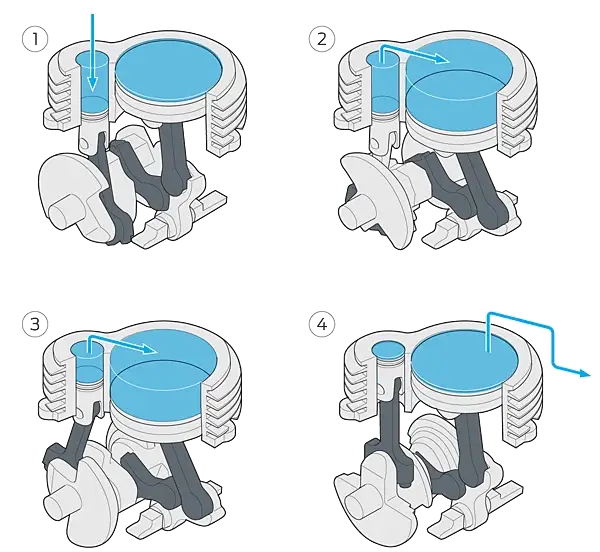
As a postscript, having after 1990 left racing behind Guy Negre went on to develop the low power zero emissions ‘air engine’ whereby two offset size and offset function pistons powering a common crankshaft are driven by compressed air. Compact cars having compressed air stored onboard have been demonstrated and the technology was even sold to Tata Motors in 2007 although to date nothing has come of that.
Negre died in 2016 but nevertheless MDI, the company he founded to commercialise his air engine continues to develop it for short range applications such as golf buggies and its Air Pod (below).

Southgate Revolution

I recall at the Spa World Sports Prototype Championship race of 1989, on my birthday asking Tom Walkinshaw for permission to produce a book on the Jaguar XJR Group C and GTP cars of 1985-88 (writes Ian Bamsey). Those were the days when my Racecar Engineering project was all about books and Tom made my day by agreeing.
With that I was off interviewing in depth the likes of Tony Southgate, Alastair McQueen, Allan Scott and Roger Silman, prising a huge amount of technical detail from them. The upshot was the Racecar Engineering imprint, Haynes Publishing Group book: Jaguar XJR Group C and GTP Cars: A Technical Appraisal of the V12 Cars by Ian Bamsey [ISBN: 0-85429-752-9]
I recall equally vividly a message I received 20 years later telling me that Tom had refused permission for me to publish an in depth technical appraisal of the Holden V8 prepared by Walkinshaw Racing for the Australian Supercars series. Having put a serious amount of work into that project I was gutted.
My contact at Walkinshaw Racing - the engineer who had given me a vast amount of detail - said that Tom had asked him what was to be gained by making public all the development they had put in to become arguably the top Holden engine builder in the series?
Happily my contact didn’t take ‘no’ for an answer and somehow - I know not how - persuaded Tom to let me publish another Walkinshaw engineering insight…
But going back to my Jaguar book research, a major revelation there was how Southgate revolutionised the Group C car underwing.
Prior to the first Southgate Jaguar all highly competitive Group C cars (having been designed during the era of full ground effect (if unskirted) Formula One cars) exploited full-length underbody tunnels.
For Tom Walkinshaw's new TWR Jaguar Group C car Southgate eschewed such tunnels. It had a new style of underwing which set the pattern for the rest of the decade.
Southgate had found that full-length tunnels made his previous Le Mans car, the Ford C100, difficult to balance aerodynamically. In the wind tunnel he found that making the tunnels increasingly shallower in the throat area made for increasing downforce. Like all major steps in race car engineering, this one was simple yet effective. Southgate opted to use the entire expanse of the car's nose, cockpit and sponson undertray area as a uniformly flat surface ahead of two big engine bay diffuser tunnels.
Southgate had discovered that the suction developed in a Prototype's diffuser section was sufficiently strong to pull in air from the sides of the car. Air that had previously been assumed to have been flowing parallel to the flanks of the car was in fact being drawn inwards, turning through 45° to sweep under the sponsons towards the area of lowest pressure, which was located immediately ahead of the diffuser. Since in the absence of lateral skirts it was impossible to stop this influx of air, it was logical to provide for it.
Conventional wisdom had it that the only effective feed for an underwing was from under the nose. However, Southgate had discovered that in the absence of lateral seals the entire concept of a venturi tube style throughflow was wrong. In the absence of side skirts air comes rushing in from the sides as well as the front.
Southgate planned for a feed from the nose and from the sides, which clearly made any form of tunnel ahead of the diffuser inappropriate. What was appropriate was attention to the way in which the air entered at the nose and at the sides. Southgate opted for a nose splitter and pronounced lateral lips - horizontal side skirts - these lips extending the splitter area along the sides of the car. This confused the air rushing down the flanks of the car, forcing it to regroup before it joined the air at ground level which was being drawn into the underwing against its natural direction of flow.
The new look tunnels started in the midst of the flat bottom area (roughly at the back of the central fuel tank) with an angled join and rose progressively forming conventional wedge-shaped diffusers, one either side of the powertrain. As usual a remote rear wing helped pull the air through the underwing.
Of course, Southgate's approach led to a greater flat-bottom area than was mandatory for Group C. He found that the pressure over the entire undersurface was no greater than zero (14.7 psi) and for the most part was negative. It was negative over something like two-thirds of the Jaguar’s underbody, this representing a plan area of at least 5000 sq in. Since the average drop at 180 mph was in the region of 1.0 psi a total downforce of 5000 lb (2268 kg) was comfortably attainable at top speed.
The Underworld

Back in the Group C days, as the cars competing at Le Mans were pushed through the various scrutineering bays a media pass holder could join those officials working at the hoist to inspect the underside of each (writes Ian Bamsey).
In 1991 the TWR team didn’t like the idea of yours truly photographing the underside of its new Jaguar XJR-14 so it had all available personnel stand shoulder to shoulder around the hoist. Happily though the last example through was for some reason called back unexpectedly. With then only the three guys tending it present there was no possibility of a human shield around it…
Designed by Ross Brawn, where the XJR-14 differed fundamentally from the preceding Southgate Jaguar Group C cars was in so far as its flat floor ran no further forward than the front wheel axis. Ahead the nose incorporated a wing running in ground effect.
The upwash from the front wing sent most of the air passing beneath it over the body but the rear diffuser was still adequately fed, including air coming in under the sides of the floor. This was Brawn’s answer to the challenge of attaining sufficient front downforce to adequately balance what could be obtained at the rear.
The next innovation was to be seen at the following year’s Daytona 24 Hour race. Wandering its friendly garage area I suddenly found the All American Racers’ stall become an unfriendly place for me to be. But it was too late for them: I had already spotted a nose section that revealed to me what they were up to…
Like the XJR-14, AAR’s Toyota-powered Eagle GTP car had its mandatory flat floor only running as far forward as the front wheel axis. But there its leading edge was exposed to the oncoming underbody airflow, splitting that flow above and below. The crucial point was that the over-floor flow wasn’t sent over the body but was ducted out through the front wheel arches. Thus was born the concept of having a nose as well as a rear diffuser.
Although I hadn’t been able to gain photographic evidence of this ploy prior to being firmly shown the door of the AAR garage I had seen enough to be able to sketch it. From that Tony Matthews drew the accompanying illustration.
Group C and GTP soon thereafter faded away but the late nineties brought a resurgence of Prototype technology.
At Le Mans in 1998 I discovered that the Toyota factory team had gone even further than AAR with its GT-One. Again it was me spotting a nose section left around in the garage area that provided evidence of the latest clever twist.
With this car the diffuser ahead of the front wheel axis incorporated a muted funnel-type nose intake instead of being fronted by the traditional front splitter. This meant that as a whole the nose underside ahead of the front wheel axis could be formed, in conjunction with the track surface below, as a venturi-like duct for the passage of the on-coming air.
Much of the air passing under the nose then travelled over rather than under the mandatory flat floor, thanks to the shape of the nose underside, working together with exit ducting that was provided above the floor. That ducting diverted the airflow either side of the forward cockpit area, sending it out through exits in the body flanks just aft of the front wheel arches.
Such an under-nose duct can be considered a 'nose diffuser' although it would not operate powerfully without the ducting beyond it, above the floor, encouraging the extraction of air from it.
But that wasn’t the end of the story since it proved possible to make a further gain by sending the air exiting over the floor through ducting that led all the way back to the tail end of the car. That rear exit flow assisted the operation of the rear diffuser…
When Prodrive had a clean sheet of paper to produce an LMP1 car to carry Aston Martin colours in 2011 it was well aware of the power of full length internal ducting. As such it logically specified an I6 engine configuration.
The AMR-One was not a success but aerodynamically it had an excellent foundation.
What is in a name?
There is a lot of excitement in the motorcycle world over the fact that Honda is developing a 900 cc V3 boosted by an electrically driven compressor (writes Ian Bamsey). Disconnecting the speed of the charge air compressor from either the crankshaft or the exhaust gas flow has a lot of obvious advantages. Nevertheless having announced its V3R 900 E-Compressor Prototype as a future production motorcycle Honda says that according to its research this use of an electrically driven compressor is a “world first for a motorcycle”.
In fact the concept has been applied to a number of motorcycle-engined Formula SAE / Student single seaters, albeit without the teams in question having had the resources to properly optimise the compressor / electric motor package.
Formula SAE / Student has long been a hotbed of innovation. I recall my good friend, the late Carroll Smith eulogising about the first electric supercharger application he came across. That was in the late 1990s when Carroll was long established as chief judge at Formula SAE.
Another good friend of mine, the late Allan Staniforth had previously encouraged his local university, Leeds, to enter the annual Formula SAE event even though it was on the other side of the pond. Out of that, in 1997 came an initiative to create a Formula SAE event in the UK.
In the UK most automotive engineers are associated with the Institution of Mechanical Engineers (IMechE); the local offshoot of the US-based Society of Automotive Engineers (SAE) has more modest representation. The upshot was the formation of a committee to organise the first UK event having representatives of SAE-UK, the IMechE and various other interested parties, including yours truly representing the media.
Concerned at the difficulty of marketing an event almost unknown outside of North America to UK universities I suggested we call it ‘Formula Student’. I figured any student at all interested in motorsport, upon hearing that title would want to find out more…
My suggestion was reasonably well received, in particular by the IMechE representative, who presumably would have preferred it called Formula IMechE rather than Formula SAE…
In fact at the very next committee meeting that IMechE representative announced, to everyone’s surprise that he had secured Formula Student as a domain name!
I recall at the initial UK event (held at MIRA in 1998) getting a certain amount of flak from SAE HQ bigwigs who had flown over for it. But they seemed to come around to accepting my strong marketing reason for the name, which was subsequently adopted also for an event in Germany.
I later learned that the main man of SAE UK had - unbeknown to most of us on the committee - put in a serious amount of funding to help get the competition underway in the UK. But I still believe that calling it Formula Student was the right thing in so far as I reckon it fast tracked the concept to UK universities…
When Did You Lose Interest?
I have to admit it: that particular headline in the Motor Sport magazine of March 1973 shocked me (writes Ian Bamsey). As a schoolboy enthusiast I had only recently discovered motor racing and it was inconceivable to my young mind that anyone could lose interest in this magnificent sport.
The article was written by DSJ (Denis Jenkinson - the proprietor of Motor Sport and Motoring News, Wesley J. Tee, only permitted the use of initials). DSJ bemoaned the number of people telling him they had lost interest in Grand Prix racing. He pointed out that it was normally almost impossible to pin down when specifically the complainant had actually lost interest. And that often they had a knowledge of the current scene that was remarkable for someone who claimed to have become disinterested!
DSJ then brought up the concept of “Professional moaners who keep in touch with all the latest trends just so that they can complain”. He explained: “There is a cult today that it is fashionable to be ‘bored by it all’ and in that cult you are not permitted to show any enthusiasm for anything, unless it is enthusiasm for being bored.”
While DSJ further remarked, “Underneath they are probably as enthusiastic as any of us”, I wonder if that is true of those who today say they have lost interest?
In 1973 Grand Prix cars had evolved implausibly since racing resumed after the war. They continued to evolve for the rest of the century whereas in this century there has been less fundamental change, at least superficially.
That is to say, we haven’t seen a switch from front to mid engine, from treaded tyres to far wider slicks, from streamlining to ground effect aero and so forth. What we have seen though is a gradual trend towards the elimination of technical competition, a phenomenon now prevalent across most forms of racing.
There are literally thousands of talented people involved in the design and development of the new for 2026 Formula One power units. But those are homologated and then straightjacketed in respect of development potential.
Moreover, going forward if any power unit is found to be out of a narrow performance band relative to the others it will have special dispensation for the development necessary to catch up.
A form of performance balancing? At least this isn’t as bad as the situation today in so many other forms of racing, where there is typically either the use of a spec engine or a cap on performance imposed by torque sensors monitored by the rule maker.
The latter is now the case at Le Mans, where the cars are subject also to aero performance capping. On top of that there is a system of ‘balance of performance’ aimed at giving every competitor an equal chance of winning.
People talk of this being the Golden Age of Le Mans.
Yes, there is indeed an impressive lineup of participating manufacturers. And the cars do at least look and sound different from each other. But Le Mans was previously a great human and technical adventure. Nowadays the technical element has been removed: with all the cars artificially equalised success comes down to the drivers and the teams.
That is why I lost interest in Le Mans. I still follow Grand Prix racing but I fear that, while we might eventually get a return to great sounding V8s (running on sustainable fuel), by that stage the cars will likewise be artificially equalised. As they are in most other forms of racing today…
When did you lose interest?
But even if you have done, you can rest assured that you will be inspired by Project Four!

